GL.iNet Spitz Plus (GL-X2000) review
Who is this for? People who want a fixed 4G LTE connection as a primary or backup WAN link, with built-in VPN management, a kill switch, and network-wide DNS filtering — without a separate router or per-device VPN client.
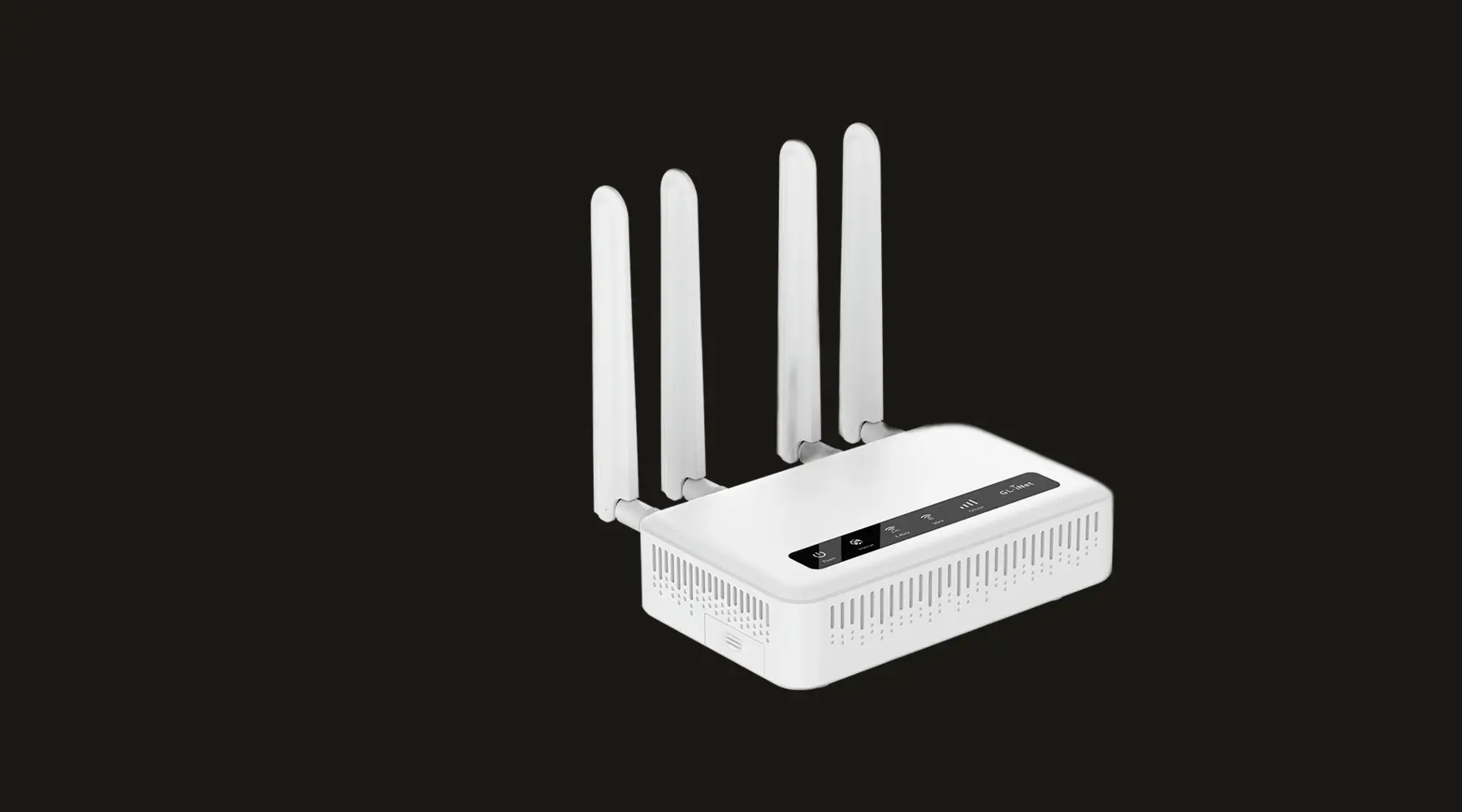
GL.iNet Spitz Plus (GL-X2000) review
Who is this for? People who want a fixed 4G LTE connection as a primary or backup WAN link, with built-in VPN management, a kill switch, and network-wide DNS filtering — without a separate router or per-device VPN client.
The Spitz Plus is not a travel router. It is a desktop LTE gateway: it needs a power adapter, weighs 443 grams, and sits on a desk or in a server room. That makes it suitable as a fixed LTE replacement for a DSL line, as a backup WAN alongside a wired connection, or as a privacy-friendly network core at a location without cable internet.
The price is not officially published; expect around €100–130 based on comparable GL.iNet models.
Specifications
| Spec | Value |
|---|---|
| CPU | Qualcomm dual-core @1 GHz |
| RAM | 512 MB DDR3L |
| Storage | 128 MB NAND Flash |
| Wi-Fi | Wi-Fi 6 dual-band: 574 Mbps (2.4 GHz) + 2,402 Mbps (5 GHz) |
| 4G | LTE CAT12, Quectel EG120K |
| Bands (EMEA) | FDD B1/3/5/7/8/20/28/32; TDD B38/40/41 |
| SIM | 2× nano-SIM (dual SIM, single modem) |
| Ethernet | 2× Gigabit (1 WAN + 1 LAN) |
| USB | 1× USB 2.0 |
| OS | OpenWrt |
| Power | 12V/2.5A default; 9V–36V range |
| Consumption | <14 W |
| Dimensions | 141 × 86 × 36 mm, 443 g |
| Price | around €100–130 (check current price) |
WireGuard performance
GL.iNet specifies WireGuard throughput of around 190 Mbps. That is lower than the Wi-Fi 7 travel routers in GL.iNet’s lineup, but more than sufficient for a typical LTE connection of 50–200 Mbps. In practice, the bottleneck is the 4G connection, not the VPN throughput.
OpenVPN reaches around 30 Mbps — only relevant if your VPN provider does not support WireGuard.
Spitz Plus vs Brume 3
| Brume 3 (GL-MT6000) | Spitz Plus (GL-X2000) | |
|---|---|---|
| WAN type | Ethernet / Wi-Fi repeater | Ethernet + 4G LTE SIM |
| WireGuard | ~700 Mbps | ~190 Mbps |
| Wi-Fi | Wi-Fi 6 dual-band | Wi-Fi 6 dual-band |
| SIM | No | 2× nano-SIM |
| Ethernet | 5× (4 LAN + 1 WAN) | 2× (1 WAN + 1 LAN) |
| DPI | Yes | No |
| Price | around €100 | around €100–130 |
The Brume 3 is the stronger choice if you already have a wired internet connection and want maximum VPN throughput. The Spitz Plus is the choice when 4G LTE is a requirement — as a primary connection or as failover.
Multi-WAN and failover
The Spitz Plus supports multiple WAN sources simultaneously: wired WAN port, 4G LTE SIM, and USB tethering. Failover automatically switches to the available connection. This makes it useful as:
- A primary 4G gateway at a location without cable internet
- Backup WAN alongside a wired line — if the DSL goes down, LTE takes over
- Balanced multi-WAN for locations with two available connections
Load balancing is configurable via the web interface.
Dual SIM
The Spitz Plus has two nano-SIM slots but one modem: two SIM cards can be present, but only one can be active at a time. Switching between SIM cards is done via the web interface.
This differs from the dual-standby approach of the Mudi 7. Use dual SIM here for SIM switching (different providers, roaming backup) — not for simultaneous dual-SIM connectivity.
OpenWrt and web interface
The Spitz Plus runs the same GL.iNet firmware as the rest of the range:
- WireGuard and OpenVPN client (30+ built-in VPN providers)
- DNS-over-TLS and DNS-over-HTTPS
- AdGuard Home as a built-in DNS ad-blocker
- Multi-WAN management: failover, load balancing, and per-connection policy
- USB tethering as an additional WAN source
- Per-device VPN policy and kill switch
- GoodCloud remote management (optional)
Caveats
No 5G: The Spitz Plus uses LTE CAT12, not 5G NR. At locations with 5G coverage, a 5G gateway or mobile hotspot will give higher speeds.
512 MB RAM: Less than newer GL.iNet models (Brume 3: 1 GB, Mudi 7: 2 GB). Sufficient for routing and VPN, but less headroom for heavy network profiles or many simultaneous connections.
Lower WireGuard throughput: ~190 Mbps is lower than the Brume 3 (~700 Mbps) and travel routers like the Beryl 7 or Slate 7 Pro. In practice, 4G LTE is rarely faster than 150–200 Mbps, so this is rarely a bottleneck.
Dual SIM, single modem: Both SIM cards can be present, but only one can be active at a time. No automatic SIM failover; switching is manual or via API.
No touchscreen: The Spitz Plus has no display. Status is visible via the web interface or GoodCloud app.
Pros and cons
Pros
- Fixed 4G LTE gateway with built-in VPN management and kill switch
- Multi-WAN failover: LTE + wired WAN available simultaneously
- AdGuard Home and DNS-over-TLS built in
- Dual SIM for SIM switching and roaming backup
- Wide LTE band support for EMEA region
- Low price for the feature set offered
Cons
- No 5G
- 512 MB RAM — less than newer GL.iNet models
- WireGuard throughput lower than Brume 3 and travel routers
- Dual SIM but single modem: no simultaneous dual-SIM operation
- No touchscreen or local status display
Getting started
- Insert a nano-SIM into slot 1
- Connect the Spitz Plus to power (12V/2.5A adapter)
- Connect the WAN port to your wired internet connection (optional — LTE works without it too)
- Connect your devices via Wi-Fi or the LAN port
- Open the web interface at
192.168.8.1 - Run the setup wizard: activate SIM, configure APN
- Set up WireGuard via VPN → WireGuard Client → add your VPN provider
- Enable the kill switch
- Optional: configure failover order under Multi-WAN
- Optional: enable AdGuard Home for network-wide DNS filtering
Conclusion
The Spitz Plus solves a specific problem: a fixed LTE gateway with built-in VPN management, failover, and network-wide DNS filtering at a location without cable internet, or as a reliable backup WAN. For those who already have a wired connection and want maximum VPN throughput, the Brume 3 is the better choice. For those who want mobile networking with a battery, the Mudi 7 is the right option. The Spitz Plus fills the space in between: fixed LTE, affordable, without compromise on VPN management.
Next step
Chosen the Spitz Plus?
- Set up a GL.iNet travel router — step by step: WireGuard, DNS-over-TLS, and AdGuard Home
Similar options
- GL.iNet Brume 3 review — higher WireGuard throughput, no 4G LTE
- GL.iNet Mudi 7 review — 5G NR with battery for mobile use
- GL.iNet Beryl 7 review — Wi-Fi 7 travel router, no SIM
Want to go further?
- Which network setup fits your profile? — how much router do you actually need?