GL.iNet Beryl 7 (MT3600BE) review
Who is this for? Travellers and home users who want to upgrade from the Beryl AX to Wi-Fi 7 and significantly higher VPN throughput, without paying the Slate 7 premium for a touchscreen they don't need.
GL.iNet Beryl 7 (MT3600BE) review
Who is this for? Travellers and home users who want to upgrade from the Beryl AX to Wi-Fi 7 and significantly higher VPN throughput, without paying the Slate 7 premium for a touchscreen they don’t need.
The Beryl 7 is the direct successor to the Beryl AX. GL.iNet rebuilt it from the ground up: faster processor, Wi-Fi 7, both Ethernet ports at 2.5G, and WireGuard throughput up to 1,100 Mbps — nearly four times its predecessor. The form factor stays similarly compact, the price sits below the Slate 7, and there is no touchscreen. That is precisely the trade-off most users will make.
Specifications
| Property | Value |
|---|---|
| Processor | MediaTek quad-core @2.0 GHz |
| RAM | 512 MB DDR4 |
| Storage | 512 MB NAND |
| Wi-Fi | Wi-Fi 7 dual-band (BE3600): 688 Mbps (2.4 GHz) + 2,882 Mbps (5 GHz) |
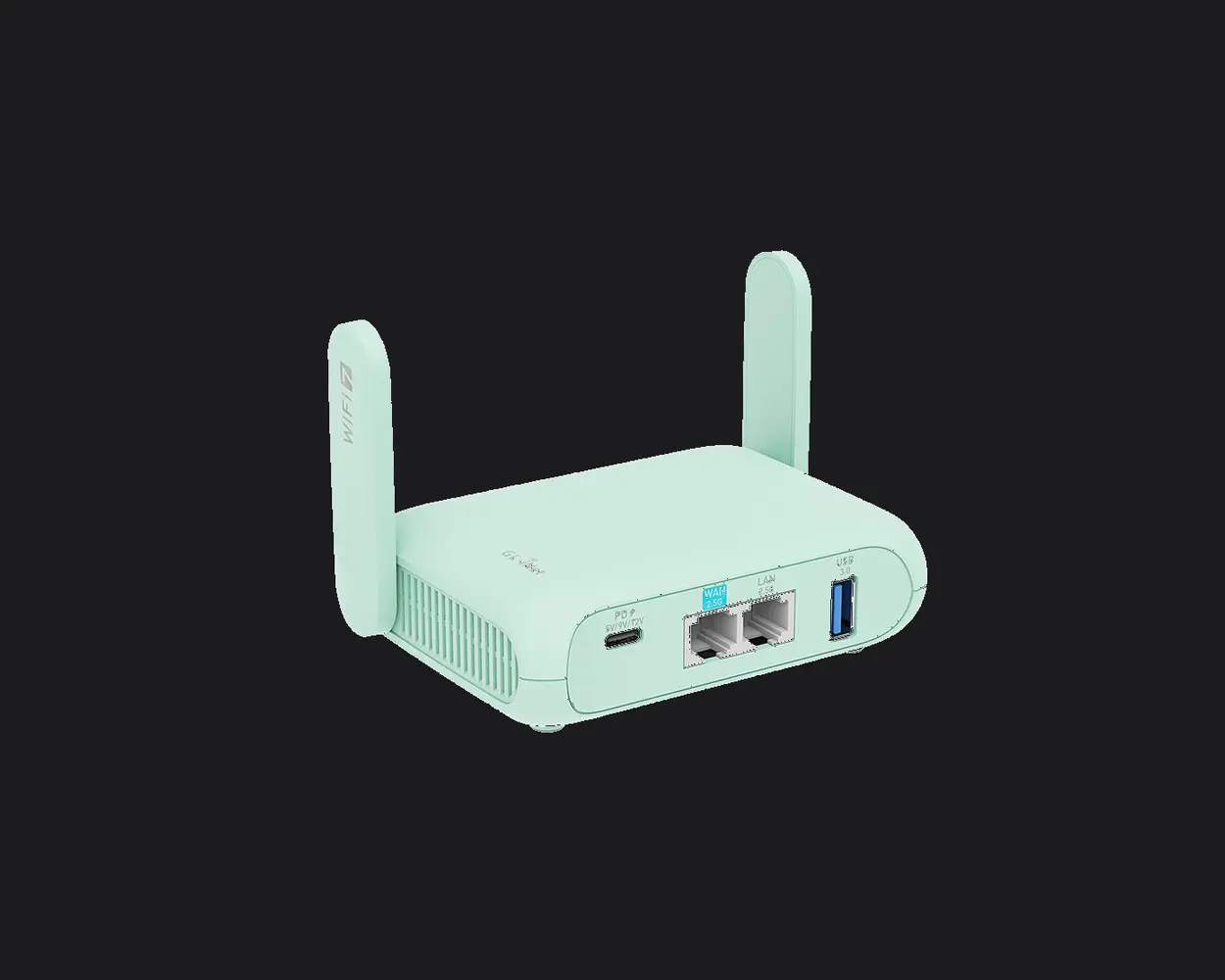
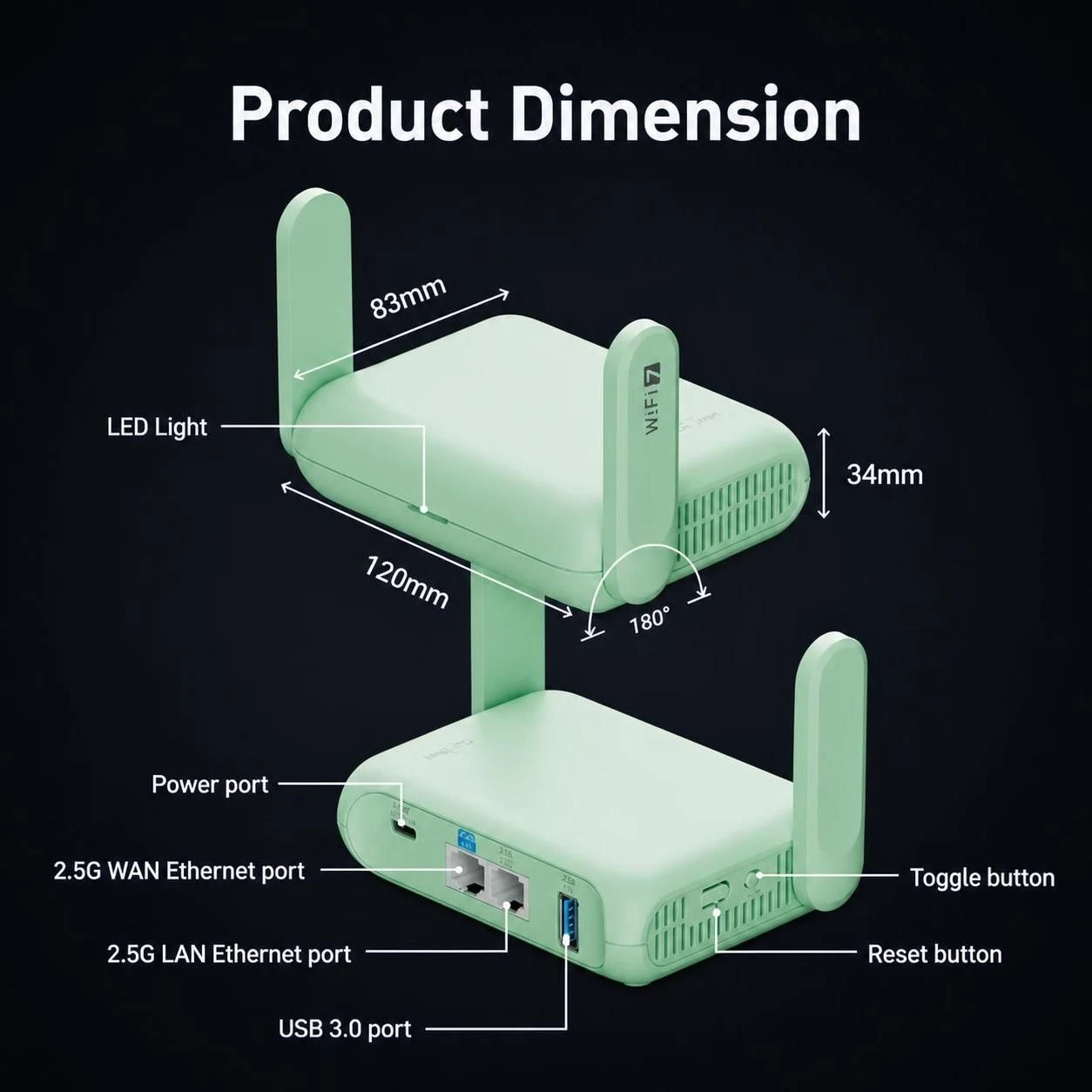
| Ethernet | 2× 2.5G (both configurable as WAN or LAN; default 1× WAN, 1× LAN) |
| Operating system | OpenWrt |
| USB | 1× USB 3.0 |
| Power | USB-C, PD (5V/3A, 9V/3A, 12V/2.5A) |
| Dimensions | 120 × 83 × 34 mm, 205 g |
| Price | around €130–140 (check current price) |
WireGuard performance
GL.iNet specifies WireGuard throughput up to 1,100 Mbps for the Beryl 7 — nearly four times the Beryl AX (~280 Mbps) and more than double the Slate 7 (~490 Mbps).
On hotel networks you will rarely notice the difference: most accommodations offer no more than 100–200 Mbps. But for home use on a 500 Mbps+ fibre connection, or for office use where you don’t want the router to be the bottleneck, 1,100 Mbps matters.
OpenVPN-DCO reaches up to 1,000 Mbps — also higher than any other GL.iNet travel router in the current lineup.
Beryl 7 vs Beryl AX
| Beryl AX (MT3000) | Beryl 7 (MT3600BE) | |
|---|---|---|
| Wi-Fi | Wi-Fi 6 (AX3000) | Wi-Fi 7 (BE3600) |
| CPU | Dual-core 1.3 GHz | Quad-core 2.0 GHz |
| RAM | 512 MB | 512 MB |
| Storage | 256 MB NAND | 512 MB NAND |
| Ethernet WAN | 1× 2.5G | 1× 2.5G |
| Ethernet LAN | 1× Gigabit | 1× 2.5G |
| WireGuard | ~280 Mbps | ~1,100 Mbps |
| Touchscreen | No | No |
| Power | USB-C (5V/3A) | USB-C PD (up to 12V/2.5A) |
The upgrade is meaningful across every spec: faster CPU, Wi-Fi 7, higher VPN throughput, and the LAN port is now 2.5G.
Beryl 7 vs Slate 7
| Slate 7 (BE3600) | Beryl 7 (MT3600BE) | |
|---|---|---|
| Wi-Fi | Wi-Fi 7 BE3600 | Wi-Fi 7 BE3600 |
| WireGuard | ~490 Mbps | ~1,100 Mbps |
| Ethernet | 2× 2.5G (configurable) | 2× 2.5G (configurable) |
| Touchscreen | Yes | No |
| RAM | 1 GB | 512 MB |
| Price | higher | lower |
The Beryl 7 delivers higher VPN throughput than the Slate 7 at a lower price, but has less RAM and no touchscreen. Both routers have two configurable 2.5G ports (dual-WAN failover possible on both); the Slate 7 additionally has a touchscreen for instant VPN status without opening a browser.
OpenWrt and web interface
The Beryl 7 runs the same GL.iNet firmware as the rest of the series. Via the web interface you can configure:
- WireGuard and OpenVPN client (30+ built-in VPN services)
- DNS-over-TLS and DNS-over-HTTPS for the entire network
- AdGuard Home as built-in DNS ad blocker
- Captive portal mode for hotel Wi-Fi login pages
- Repeater mode: connect to hotel Wi-Fi, share a secure connection with all your devices
- Per-device VPN policy and kill switch
- Multi-WAN failover
Those who want to can dig into the full OpenWrt CLI.
Use cases
Travelling: Connect the Beryl 7 to hotel Wi-Fi or an Ethernet port, set up WireGuard, and all your devices go through VPN automatically. Configure once, not per device. Captive portal mode handles hotel login pages without per-device hassle.
As a small home router: Wi-Fi 7 and 1,100 Mbps WireGuard are more than enough for a flat or small household on a fast internet connection. The Beryl 7 is the only GL.iNet travel router where VPN throughput is not the bottleneck on a gigabit home connection.
Office and remote work: For reliable encrypted tunnels from a hotel or co-working space back to your office or home server, without compromising VPN performance.
Caveats
One LAN port by default: For a wired home network with multiple devices you need a switch, unless you manually switch the second port from WAN to LAN. If you want dual-WAN failover instead, the factory configuration (1× WAN, 1× LAN) is exactly what enables it — that’s not a trade-off, it’s the default working as intended.
No touchscreen: The Slate 7 shows VPN status and speed directly on the display without opening a browser. On the Beryl 7 you open a browser for that.
512 MB RAM: Sufficient for standard use including AdGuard Home, WireGuard, and OpenWrt plugins. Less than the Slate 7 (1 GB) for those wanting to run multiple heavy services simultaneously.
VPN speed on hotel networks: 1,100 Mbps is impressive, but most hotel networks top out at 50–200 Mbps. The advantage over the Beryl AX only becomes noticeable at home or in the office.
Pros and cons
Pros
- WireGuard up to 1,100 Mbps — the highest VPN throughput in GL.iNet’s travel router lineup
- Wi-Fi 7 with more stable connections in crowded environments (hotels, airports)
- Both Ethernet ports at 2.5G and configurable as WAN or LAN — dual-WAN failover possible
- USB-C PD power — compatible with modern GaN chargers and laptop power supplies
- AdGuard Home, captive portal mode, kill switch, and DNS encryption built in
- Lower price than the Slate 7
Cons
- No touchscreen for instant VPN status (that is the Slate 7)
- Switching the second port to LAN for a wired network gives up the factory WAN port — no switch replacement for multiple wired devices without that change
- 512 MB RAM — less than the Slate 7 (1 GB)
- WireGuard advantage over the Beryl AX is only felt on fast connections
Conclusion
The Beryl 7 is the logical replacement for the Beryl AX if you are buying a new travel router today. Wi-Fi 7, a faster processor, 2.5G on both ports, and WireGuard throughput up to 1,100 Mbps make it better on every technical measure. The price sits below the Slate 7, and for users who don’t need a touchscreen — most travellers — the Beryl 7 delivers higher VPN performance at a lower cost.
Choose the Slate 7 if you want VPN status visible without opening a browser — dual-WAN failover works by default on both routers, no port reassignment needed. Choose the Flint 2 or Flint 3 if you want a fixed home router with multiple LAN ports.
Next step
Chosen the Beryl 7?
- GL.iNet travel router setup guide — step-by-step WireGuard, DNS-over-TLS and AdGuard Home configuration
Similar options
- GL.iNet Beryl AX review — the previous generation, worth considering second-hand
- GL.iNet Slate 7 review — the Wi-Fi 7 travel router with touchscreen
Want to go further?
- Which network fits your profile? — how much router do you actually need?