V2X is arriving — what it means for your privacy on the road
Vehicles are going to communicate with each other and with road infrastructure. This is no longer hypothetical: trucks operating in the Netherlands from 2026 must be equipped with on-board units for roadside communication, and new passenger cars in Europe increasingly come with V2X chips as standard.
18 June 2026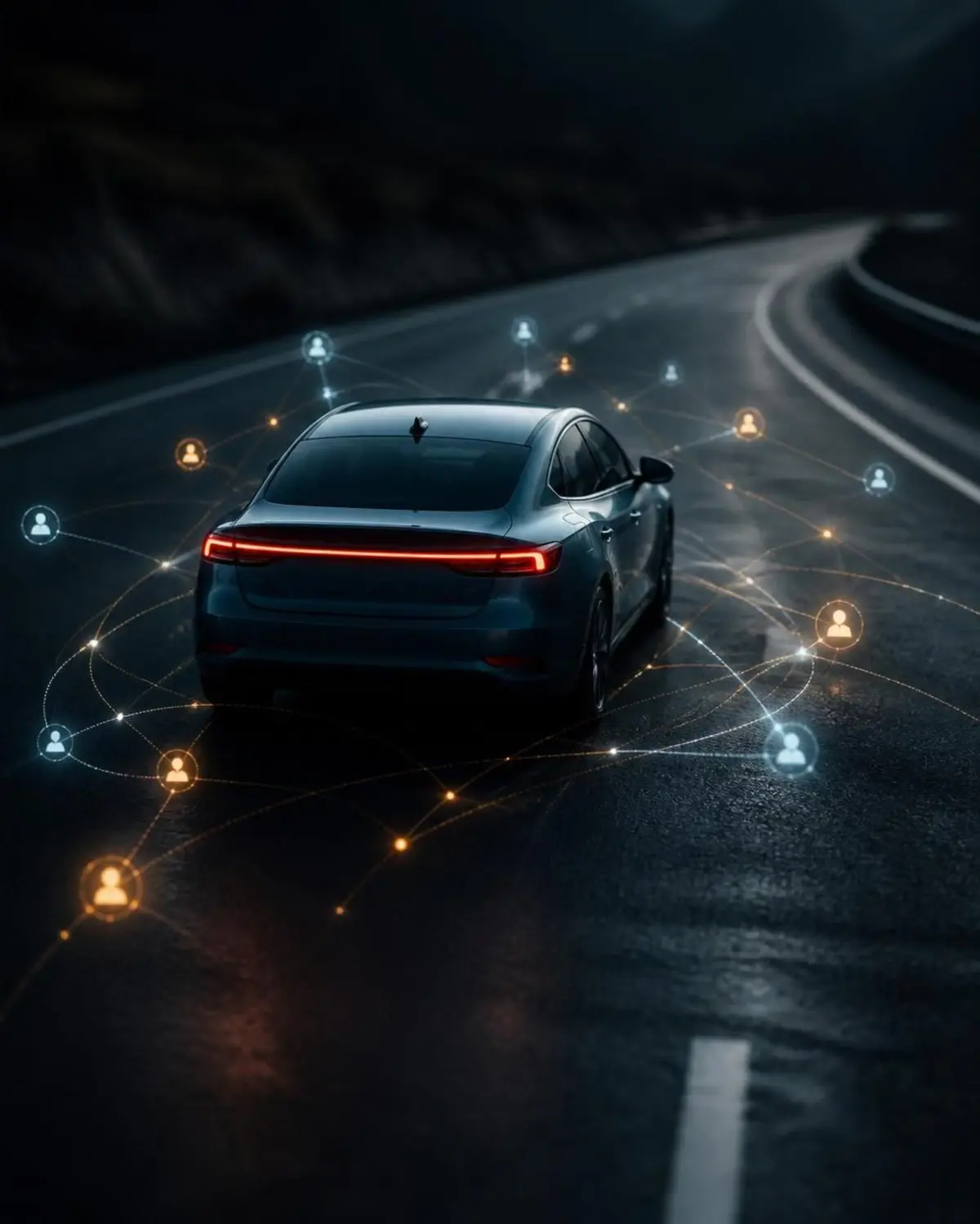
V2X is arriving — what it means for your privacy on the road
Vehicles are going to communicate with each other and with road infrastructure. This is no longer hypothetical: trucks operating in the Netherlands from 2026 must be equipped with on-board units for roadside communication, and new passenger cars in Europe increasingly come with V2X chips as standard.
V2X stands for Vehicle-to-Everything — communication between a vehicle and other vehicles (V2V), roadside infrastructure such as traffic lights (V2I), and the broader network (V2N). The goal is safety: detecting dangerous situations, congestion, and emergency vehicles faster than any human can react.
The privacy question is real, but not as simple as “they know where you drive.”
What V2X actually transmits
V2X messages are small and frequent. A typical message contains:
- current position (GPS)
- speed and direction of travel
- timestamp
- vehicle type (class, not licence plate)
These messages are broadcast to all surrounding vehicles and infrastructure — like a continuous radar signal. They are designed for local processing, not central storage.
The system is built around a specific privacy measure: pseudonym certificates. Each vehicle communicates not with its licence plate or VIN, but with a rotating temporary pseudonym. The European standard (ETSI ITS) requires this pseudonym to change regularly — every few minutes to a few hours — so that movements over time cannot automatically be linked to a single vehicle.
In theory that is a solid approach. In practice there are three weak points.
Three real privacy issues
1. Pseudonyms are not watertight
The rotating pseudonym works well when tracking one vehicle in a busy city. But on an empty motorway, or when a vehicle has a recognisable driving pattern, successive pseudonyms can be linked through position and speed. This is not theoretical — it is documented in academic research and is a known concern in the ETSI standardisation process.
The level of protection depends heavily on implementation. How often does the pseudonym rotate? Does it change in sync with a position change, or on a fixed clock? That makes a significant difference.
2. The infrastructure operator sees more
V2X messages received by a roadside unit (RSU) can be stored by the operator of that infrastructure. In the Netherlands, Rijkswaterstaat is the primary operator of motorway infrastructure. What a local municipality or private partner may do with RSU data is subject to the GDPR — but enforcement is not yet fully shaped for this specific type of mobility data.
The Dutch Data Protection Authority (AP) has already raised privacy concerns about data collected by smart traffic lights. V2X substantially increases that surface area.
3. Back-end linkage through the manufacturer
V2X itself is local radio. But modern vehicles combine V2X with a permanent mobile connection to the manufacturer. That back-end already knows your location through the manufacturer’s app, telematics, and usually the navigation service. V2X adds little technically — but it illustrates that the privacy risk of a modern vehicle does not sit in one protocol. It sits in the combination of systems.
What you can and cannot control
What is outside your control:
- V2X has no user toggle — it is built into the vehicle’s onboard computer, not a separate component you can switch off or remove
- Whether your new car includes V2X hardware (increasingly standard)
- Whether the infrastructure around you collects V2X data
- How long roadside operators retain that data
What you can control:
- Where V2X is managed through an app or service: check privacy settings and data sharing with the manufacturer
- Avoid navigation services that send driving behaviour to third parties if that matters to you
- Follow what the AP and organisations like Privacy First publish about mobility data — this area is actively developing
Why this is relevant now
V2X is not future music. In the Netherlands:
- trucks are required from 2026 to have on-board units for tolling and roadside communication
- pilot programmes on the A58 and other corridors are already running V2I communication
- the EU requires basic V2X use cases from 2026, with advanced applications from 2029
The technology is rolling out while the privacy regulation is still being worked out. That is the moment to understand how it works — not once it has become fully normalised.
Stopping point
For most readers there is nothing active to do right now. V2X affects you as a driver, not as a smartphone user. The relevant step is: follow developments and understand what your car already transmits through its factory connection — that is the larger and more immediate privacy surface.
Next step
More on vehicle and location privacy
- Organic Maps review — navigation without your location data reaching Google or Apple
- OsmAnd review — offline navigation with more control over map data